

Batya Lishansky (1900 – 1992)
In the Presidential Cabin and on the YBZ campus there are two unique works of art – a carved wooden Menorah and a bronze relief of The Silver Platter. Both of these were created by Batya Lishansky, a world-renowned sculptor who was considered by many to be a representative sculptor of the Yishuv and the State of Israel.
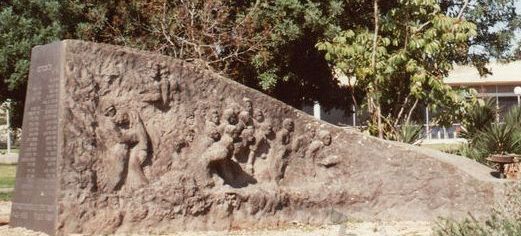
Lishansky was awarded the Israel Prize and the Dizengoff Prize (receiving the latter twice), and her works were exhibited in Israel and abroad. Among her major pieces is Work and Defence at Kibbutz Hulda, which together with The Roaring Lion by Abraham Melinkoff at Tel Hai, were considered the beginnings of monumental sculpture in the Yishuv.
Batya Lishansky was born in 1901 in Malin, Ukraine, the youngest of four daughters. Her sisters were all active in the Zionist movement: Sara, who was a nurse in Palestine; Tamar, who became a doctor, and Golda – known also as Rachel Yanait Ben-Zvi, who was to become one of the leaders of the Labor movement and of the Yishuv.
Batya immigrated to Palestine in 1920 at the age of 10 and attended the Hebrew Gymnasium in Rechavia. She then studied at Bezalel for a year and in 1920 traveled to Rome to study at the Academy of Art. When riots broke out in 1921, she returned to Palestine and settled in Ein Harod with her comrades from Gdud Ha-avoda (Labor Battalion). In 1923, just before becoming a member of the kibbutz, her yearnings for the art world compelled her to move to study sculpture in Berlin, and from there she moved to Paris. In 1926 her work was displayed at the Salon des Refusés and was received favorably. She returned to Palestine in 1929, and began to work in wood, stone and plaster, creating small statues. About one of them, depicting a trussed goose, the poetess Rachel wrote in 1935: "I stood in front of it for a long moment, looking at it, looking at myself through it… this is the power of lyrical expression."
Although she had been abroad for a long time, Lishansky was considered a characteristic artist of the Land of Israel. She is emblematic of the artists who saw themselves as mediating and empowering the national idea through art which is based on universal values and contemporary trends.
Batya Lishinsky knew hardships throughout her life, and for long periods she lived with her sister, Rachel Yanait Ben-Zvi and her family in the cabin in Rechavia. Her partner Annie Neumann passed away at a relatively early age, and her beloved nephew, Eli Ben-Zvi, with whom he had a close relationship when he grew up, was killed in the War of Independence. In his memory and the memory of his comrades, Batya created sculptures which were placed at Beit Keshet and at the Kadoorie Agricultural School. Having no children, Batya viewed her work as her progeny. Her sculptures and reliefs can be found in moshavim and kibbutzim, in urban settings and in educational institutes. Wooden menorahs that she carved – identical to the one in the Presidential Cabin – can be found in the Hanasi synagogue in Jerusalem, in the Histadrut House in Tel Aviv and in the offices of the International Labor Organization in Geneva.