

Upon entering the Yad Ben-Zvi campus, one passes through the atrium of a unique building, rich with historical and social significance: the Jerusalem "House of Pioneer Women". The building was opened during the Holocaust and built on the site of the women's agricultural farm established by Rachel Yanait Ben-Zvi in Rehavia in 1924.
Women for Women: The House of Pioneer Women
"Houses of Pioneer Women" were established in Haifa and Tel Aviv in the 1930s, with the aim of serving as "a house to absorb aliyah, for vocational training and a creating a workplace". The establishment of these houses was the initiative of "The Women's League for the Land of Israel", an organization of Zionist women in the USA founded in 1925. In addition to giving new female immigrants a place to stay and training them upon their arrival, the houses also provided lessons, cultural events and trips to familiarize the women with the country and the Zionist settlements. The Houses held training workshops, and were affiliated with cooperative factories which offered the women employment (sewing, book-binding, laundry services etc.) and financial support. As Esther Zmora put it: "take the girls in, give them a home and [thus] create a Hebrew environment in the Land of Israel".
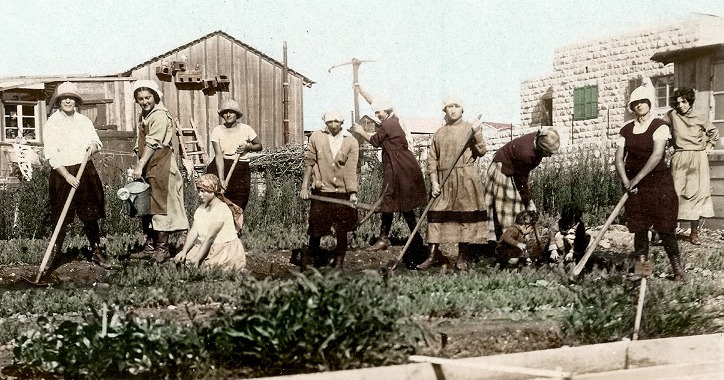
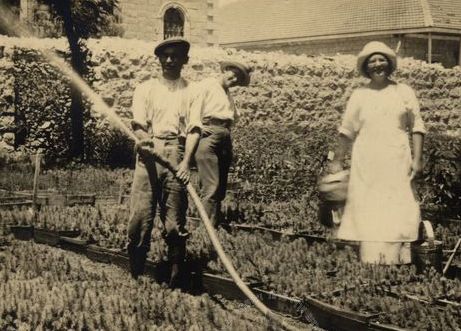
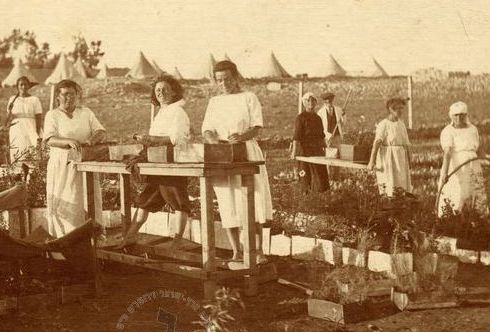
The House of Pioneer Women in Jerusalem was built on the site of the garden center which had been used since the 1920s as a complex for women's agricultural and socialist activities. Rachel Yanait's women's agricultural farm moved to Talpiyot in 1928 and later became an agricultural school for girls, leaving the garden center in Rehavia. The biggest challenge facing the Houses for Pioneer Women was having enough residential space. Following their training, new olot were supposed to find their own lodgings, but the rise in property prices at the end of the 1930s and the beginning of the 1940s meant that this was not an easy task for new pioneer women. This housing shortage became even more acute with the outbreak of WWII, when new arrivals barely escaped Nazi Europe.
Building a new home
Faced with an increasing stream of refugees in the 1930s, Rachel Yanait decided to apply to the Women's League in New York, proposing they assist with the establishment of a new building at the agricultural school in Talpiyot; in return the League would receive two-thirds of the garden center in Rechavia – slightly more than two acres – for the construction of a Pioneer Women's House. The Women's League in New York accepted the proposal and took upon itself the construction of the House for Pioneer Women in Rehavia. Donations were transferred to the executive body of the Women Workers, the Habona association, which leased the site from the Jewish National Fund..
In December 1939 the "Committee for the House of Pioneer Women", which included representatives from the Women's League and the Committee of Women Workers announced a competition to select an architect who would design the building. The tender was written in light of the lessons learned when building the Houses for Pioneer Women in Haifa and Tel Aviv, and defined the size of the various spaces in the building and their purpose. The 500sqm building was to include two stories and a basement, with the option of adding a third story. The competition was won by Zalman Baron and Genia Averbuch-Alperin, a graduate of the Herzliya Hebrew Gymnasium and of the Royal Academy of Arts of Brussels who was known as one of the architects of the International Style in Palestine. Her projects include the Zina Dizengoff Circle, the Macabbia Stadium and the adjacent Galina Café, the Haddasim Youth Village, the synagogue at kibbutz Ein Hanatziv and others.
The cornerstone of the House was laid on April 7th 1940, and the founding declaration mentioned the challenges facing the founders in Palestine and the world:
On 28th of Adar II 5700 since the Creation, 1870 years since the destruction of the Temple, the cornerstone of the House for Pioneer Women is being laid, at the very time of the destruction of German Jewry and the terrible Holocaust of the Jews of Poland, an unparalleled event in our history since the destruction of the Temple […]. With the building of this new House, we are doing the work with one hand and holding a weapon in the other […] and this building is being built now, in this day and age, as a sign that we shall rise up and we shall build
The House’s neighbor who lived in a cabin next door, Izhak Ben-Zvi, head of the Va’ad Leumi, recognized the importance of this project and its location:
This is not a time for idle talk, and speech is pointless without action […] Jerusalem is rich with institutions, organizations of lovingkindness and charity, institutes of Torah and spiritual life. It is less fortunate when it comes to enterprises aimed at ensuring livelihoods and expanding the absorption of immigration […]. Here we are, at to this small celebration, in which the cornerstone for the foundations is being laid, the foundation of a house which shall nurture within a seed of life, by nurturing the pioneer women and working mothers in Jerusalem
The seeds of a life in Jerusalem
Construction of the building dragged on and exceeded the budget due to difficulties created by the war. It was finally inaugurated on February 21, 1943. It included eight workshops, a kitchen where women could be trained, a dining hall, a club for mothers and women workers, a large hall, offices, janitorial offices and apartments for the guard and for the manager (Magda Cohen). During the ceremony, cars arrived bearing the "Children from Teheran", refugees from the Holocaust, who were given a home at the House after months of wandering the world. The first production job at the House was sewing items for the British military; this supplied employment to almost 100 women. Due to the lack of space, some of the classrooms were converted into residences and many lessons were held in the dining room. During the summer, the sunlit building, surrounded by greenery, was used for the families of British soldiers on vacation.
At the same time, various workshops were opened: cooking, weaving, sewing, toy manufacturing etc. Night classes were also held at the House (in Hebrew, English and maths), and the hall was occasionally rented out for cultural events, such as concerts and lectures. Almost a year after the end of the war, in April 1946, the addition of floors for rooms on the east and west wings of the building was completed.
During the War of Independence, women lived in the House and it was used for various cultural events. During the bombings, some of the residents were injured. For a while, the building was also used as a radio station. After the establishment of the State of Israel, the House was still used for young immigrants and female students, but activity in the House diminished towards the end of the 20th century. In the early 2000s Yad Izhak Ben-Zvi, which was located on the adjacent lot, bought the House and thus the area of Rachel Yanait's garden center was reunited with the building. In 2005 another architectural competition was held for a renovation of the building which was now marked for conservation. This time the competition was also won by a woman – Ada Karmi-Melamed. This closed another historical circle: Ada's mother, Chaya, was for a while a roommate of Genia Averbuch-Alperin when they studied in Europe.
The renovation of the building revealed several treasures: one familiar one is the Flower Hut where the products of the garden center and the agricultural farm were sold to the residents of Rehavia. A surprise find was also revealed: excavations for the new auditorium exposed a weapons cache with grenades. Today the House is used for classes, offices of Yad Ben-Zvi's culture and education departments, a library, an archive and a book shop. On the wall of the gallery in the entrance is a unique stone map of the Land of Israel, carved by one of the members of the Labor Battalion (Gdud Ha'avoda) in the 1920s.
The area of the garden center is green again, and educational and cultural events are always going on, a living testimony to the vision of Rachel and Izhak Ben-Zvi. The various transformations of the House are an outstanding reflection of the history of the Zionist settlement of Jerusalem, of ideological and social ideas from the Mandatory period up until the present day, and of the importance of women to the Zionist enterprise.