

The Silver Platter
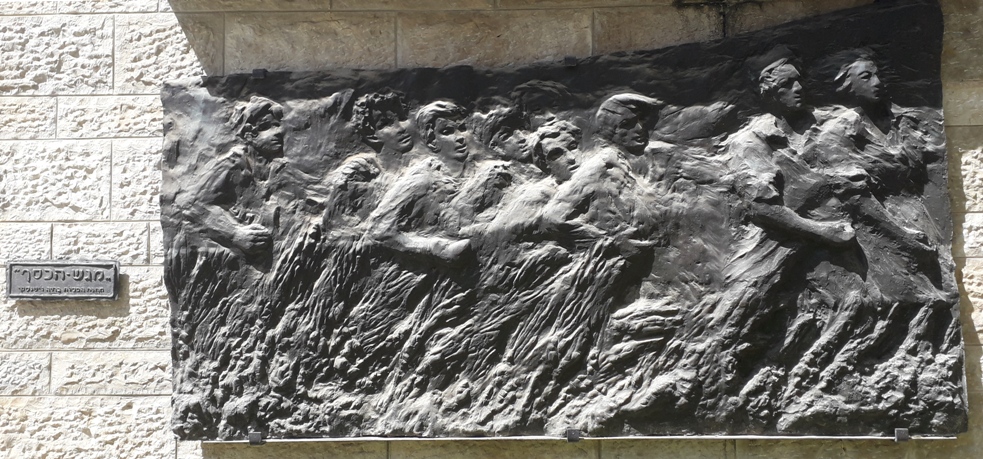
After the Six-Day War, artist Batya Lishansky created a bronze relief titled The Silver Platter which stands today on the grounds of the YBZ campus. The relief was inspired by the poem of the same name by Natan Alterman, which was in turn inspired by Chaim Weizmann’s remark about the price paid for independence: “No State is handed to a nation on a silver platter”. The relief shows nine figures rising out of a wheat field, facing forward and walking close together; the composition creates a feeling of forward motion. At the front are the figures of a young man, wearing a woolen hat, and a young woman. The young people are bent forward, as if under the weight of a silver platter.
The relief symbolizes the sacrifice made by the young people of Israel who work the land and have no choice but to go out to protect their country. Among the figures is Eli Ben-Zvi – second son of President Itzhak Ben-Zvi and Rachel Yanait and Lishansky’s beloved nephew – who was killed during the War of Independence near kibbutz Beit Keshet in the Lower Galilee. At the kibbutz there is another bronze relief made by Lishansky in 1958, similar to the one at YBZ but larger and more complex.
The Ma’on Mosaic
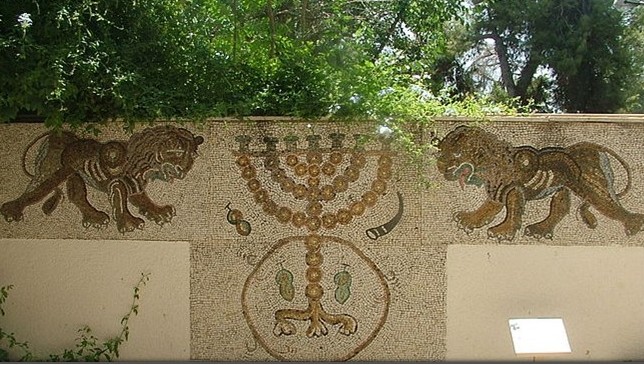
Near the original entrance to the Presidential Residence, in the Kuzari Garden, is a colorful mosaic depicting a seven-branch Menorah, placed between two lions with a shofar and etrogs on either side. This is a replica of a detail from a mosaic found in the ancient synagogue in Ma’on, near kibbutz Nirim in the Negev. The replica was made by the artist Noemie Hanreck in 1957 at the request of Rachel Yanait Ben-Zvi. The mosaic was made mainly with stones gathered in the fields of the Negev. This is an outstanding example of the revival of the ancient art of the mosaic which was then used to give shape to the ideal of Israeli statehood.
The mosaic was used as a frame and a background for the Ezekiel Tablets, and in the 1980s was moved from its original spot. Another section, which in the past was removed from Hanreck’s mosaic, was given by the artist to YBZ and restored to its place in the mosaic.
The Wooden Menorah
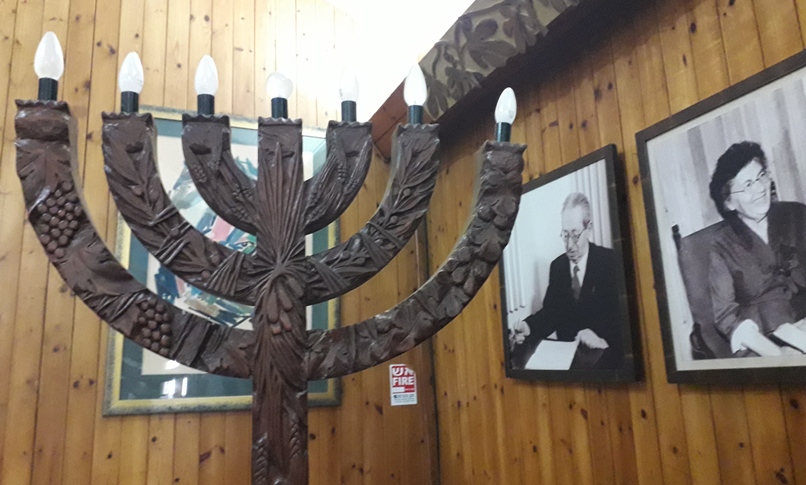
In the President’s Cabin stands a large seven-branch wooden menorah, with lights at the top. The menorah was made by Batya Lishansky – Rachel Yanait Ben-Zvi’s sister – in 1954. The menorah’s branches and base are decorated with some of the Seven Species with which the Land of Israel was blessed: figs, olives, dates and barley. These decorations correspond to the decorations which appear along of the walls of the Cabin – wooden reliefs of figs and vines. On the base of the menorah is a hand-written engravement which reads: President’s Residence, Jerusalem 1954. Similar menorahs made by Lishansky can be found in the Hanasi synagogue in Jerusalem, in the Histadrut house in Tel Aviv and in the offices of the International Labor Organization in Geneva.
The Tribes’ Table
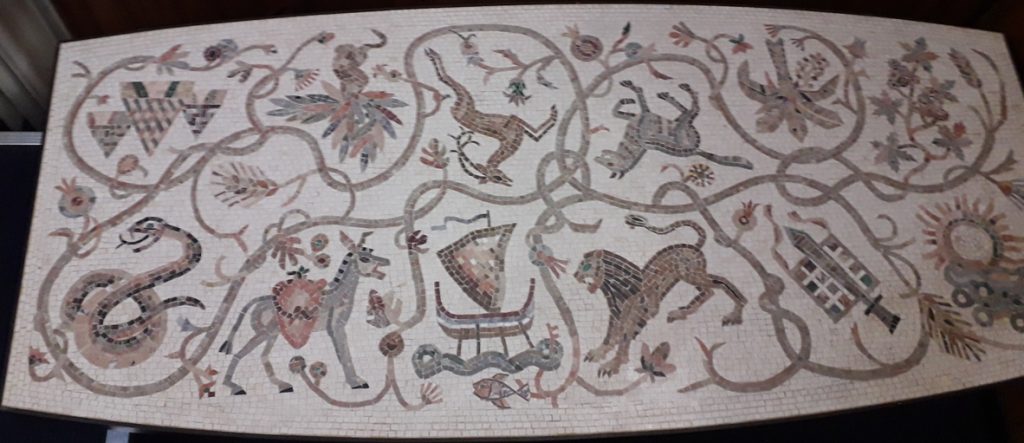
In the President’s Cabin is a solid wood table with a mosaic depicting the symbols of the Twelve Tribes of Israel. The Tribes’ Table was presented to the Presidential Residence when Izhak Ben-Zvi was appointed to his third term, in autumn 1962. The table was made at the Leshem factory in kibbutz Givat Brenner. The factory was founded and run by Shosh Spector, who was the highest-ranking female officer in the Palmach (and the widow of Zvi Spector, the commander of the 24 soldiers lost in Operation Boatswain in 1941). The factory’s aim was to give senior members of the kibbutz gainful employment which would not be physically taxing, and to revive the ancient art of the mosaic in Israel.
The Maskit Carpets
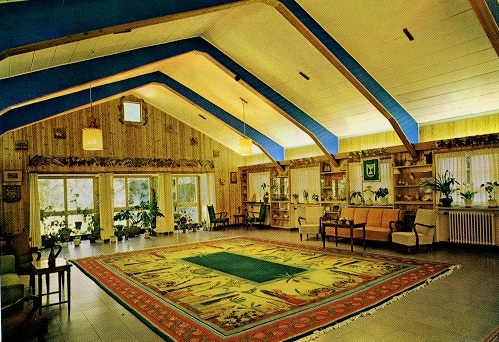
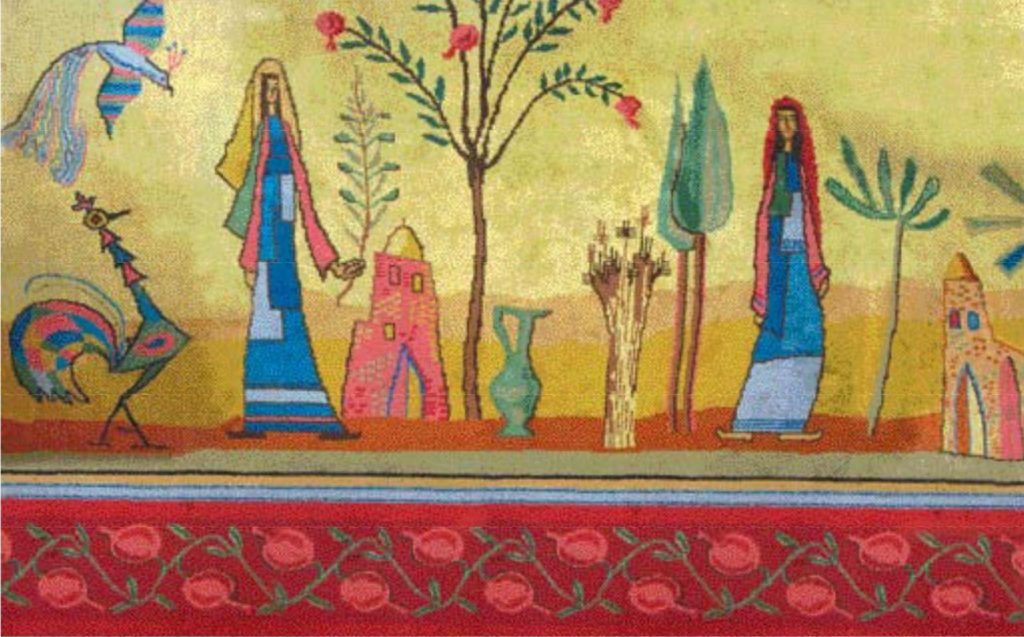
The floor of the President’s Cabin is adorned by a large carpet made in the Maskit factory. This unique and monumental work of art was created in 1956 especially for the Presidential reception hall during Izhak Ben-Zvi’s term. The carpet was weaved in the Maskit factory in Umm al-Fahm, at Rachel Yanait Ben-Zvi’s initiative. The carpet was designed by painter and author Oded Burla, the son of an old Jerusalemite family. Factory manager was the artist Vasil Mandel, an immigrant from Romania, who planned and carried out the weaving of the carpet following the Persian tradition of knotted carpets. Ruth Dayan, founder of Maskit, oversaw the work and the details of the design were approved by Rachel Yanait. A diagram of the carpet’s design by Oded Burla with Rachel Yanait’s signature can be found in the YBZ archives.
The local landscapes depicted in the carpet are inspired by the Song of Songs, and colorful birds appear alongside women in traditional garb and domed stone houses. They are surrounded by cypress trees, flowers, and trees laden with fruit from the Seven Species: dates, pomegranates, grapes and figs. Shades of yellow and bright blue – typical of the local landscape – dominate the center of the carpet. It is a unique work of art, composed of purely local elements. In form and content, the reception hall – the Cabin – was an expression of making do with little and of the homeland’s landscapes.
In 2018 other Maskit carpets were presented to YBZ – the generous donation of Nadav and Carmela Reznik. The designs of these carpets were inspired by various biblical verses.