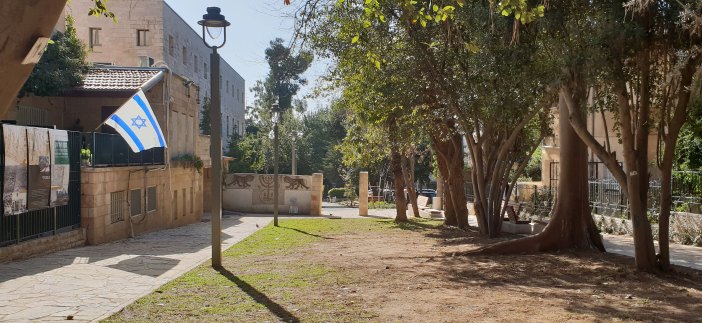
In the heart of the original Rechavia neighbourhood is a tree-lined boulevard which runs between the Hebrew Gymnasium on Kakal street and the playground on Ramban street. The boulevard was planned as a “green axis” in the heart of the neighborhood by the architect Richard Kaufmann, who planned Rechavia and other garden suburbs. The boulevard’s width and name changed several times over the years, and today it is a pedestrian walkway.
When the neighborhood was founded, the boulevard was named after Rabbi Yehuda Halevi, the poet and philosopher of the Golden Age in Spain, who was famous for his yearning for Jerusalem. After the establishement of the State of Israel, the boulevard was named “The Kuzari Garden” after the name of Yehuda Halevi’s famous book. This was a green and peaceful boulevard, a central axis which ran through the neighborhood. It was surrounded by a fence and gates, and trees and flowers were planted along it. A tennis court was laid in the garden to its south – the “Tennisplatz”, as it was known to the yekkes who arrived in the neighborhood in the 1930s.
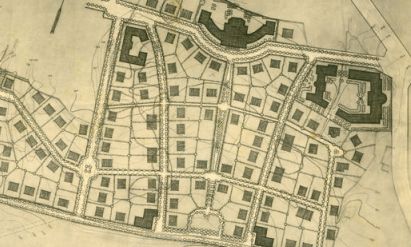
Over the years the boulevard lost its original dimensions and became narrower. This process was described by Yaron Haezrachi, whose parents’ house is close to the edge of the boulevard:
At the top of the boulevard they have built a kiosk which blocks the entrance…when Izhak Ben-Zvi was appointed President, he lived in the adjacent building… as is well known, the President needs a guard booth and a private garden. So there was no choice but to cut up the public park and to annex it to the nearby house, and to build a high fence to keep away troublesome passersby… the truncated tail of the boulevard… had shrunk even before that when the neighborhood committee gave permission to add two lots for building on either side…this is the tale of the birth, life and death of the Yehuda Halevi Boulevard.
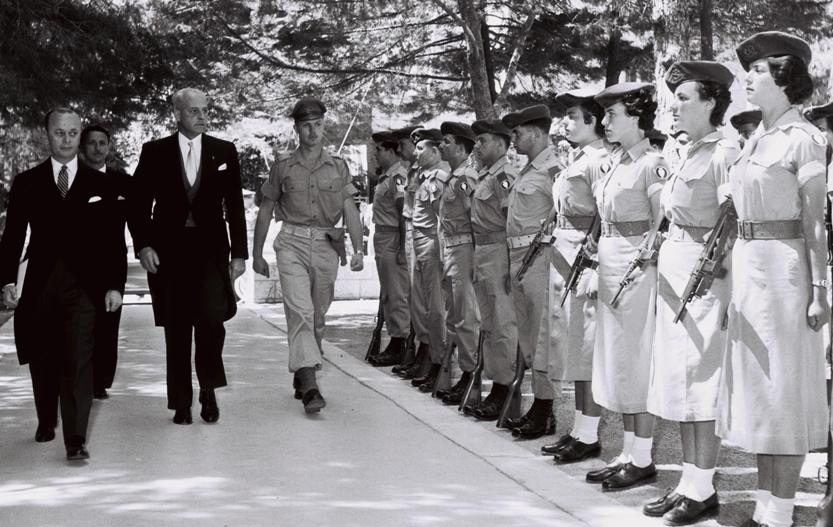
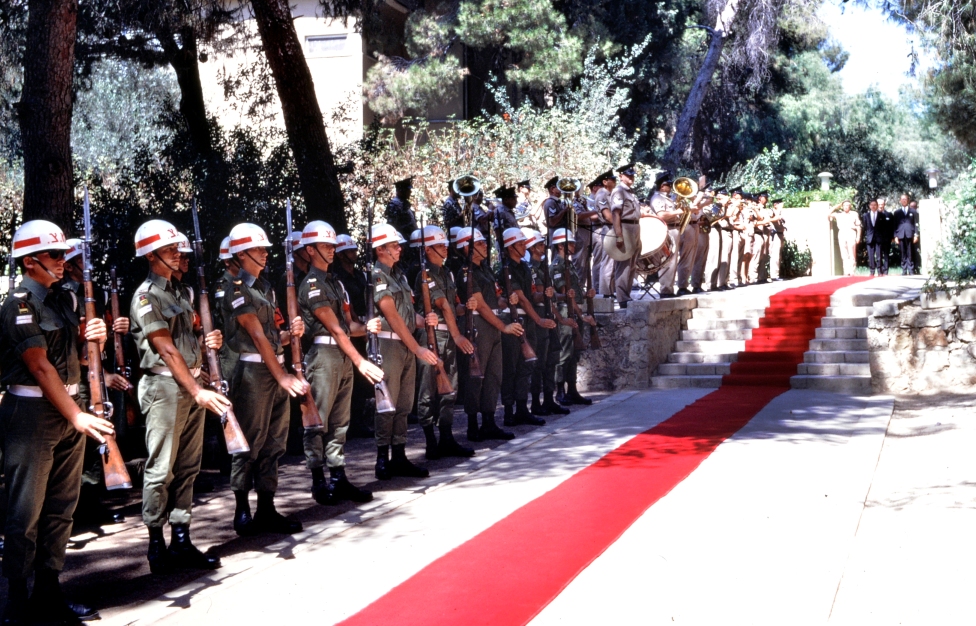
And indeed, in 1953 a large part of the boulevards was taken for the Presidential Residence’s garden and a wall was built around it. In the garden, which was planned by the landscaper Meir Victor, was a lawn and a yard with flagstone paths and an abundance of trees and shrubs. The official entrance to the President’s Cabin was from the Kuzari garden, where an official walkway for receptions was laid. Military honor guards and the police orchestra stood at attention on the sides on the paths. State cars would stop on Abarbanel street and ambassadors, royalty, heads of state and religious leaders would step out. Rechavia’s green axis was an official axis which became the backdrop to crucial moments in the history of the State of Israel and the institution of the President.
In spite of being told not to get in the way, the neighborhood children would gather around the path, curious to see the visitors in their official garb. Rechavia’s old-timers remember that before the official reception held for an African diplomat, the children were warned to not make fun of the visitor’s colorful official costume. When the entourage finally arrived, the children couldn’t help but laugh – the diplomat and his entourage were all wearing Western-style suits.
At the bottom of the boulevard is the playground known as The Giraffe Park, so called after the statue by Avraham and Hanna Yachin on the roof of the nearby kiosk. It is also known at the Frog Park, named after the statue by Dov Heller. The official name of the park is the Eliezer Yellin park, named in honor of the architect who was one of the founders of the neighborhood and whose house was the first to be built there.
The Presidential Residence moved to Talbiyya at the beginning of the 1970s, during Zalman Shazar’s term. In 2018 the wall around the garden was taken down and the boulevard returned to its original width, with grass and benches spread under the sheltering trees. In cooperation with YBZ, the neighborhood’s representatives and with the assistance of the local council and the Jerusalem municipality, architects Rachelle Wiener and Or Kahana restored the boulevard’s verdant beauty.
Among the path’s paving stones is the trunk of a pine tree which collapsed under the weight of a heavy snowfall a few years ago. In one of her books, Rachel Yanait wrote that in 1924 she was given a unique gift by a personal friend of Ben-Zvi: “seeds from cypresses and pine trees growing on the Temple Mount.” Could this be the origin of the tree which collapsed?